January 14, 2026
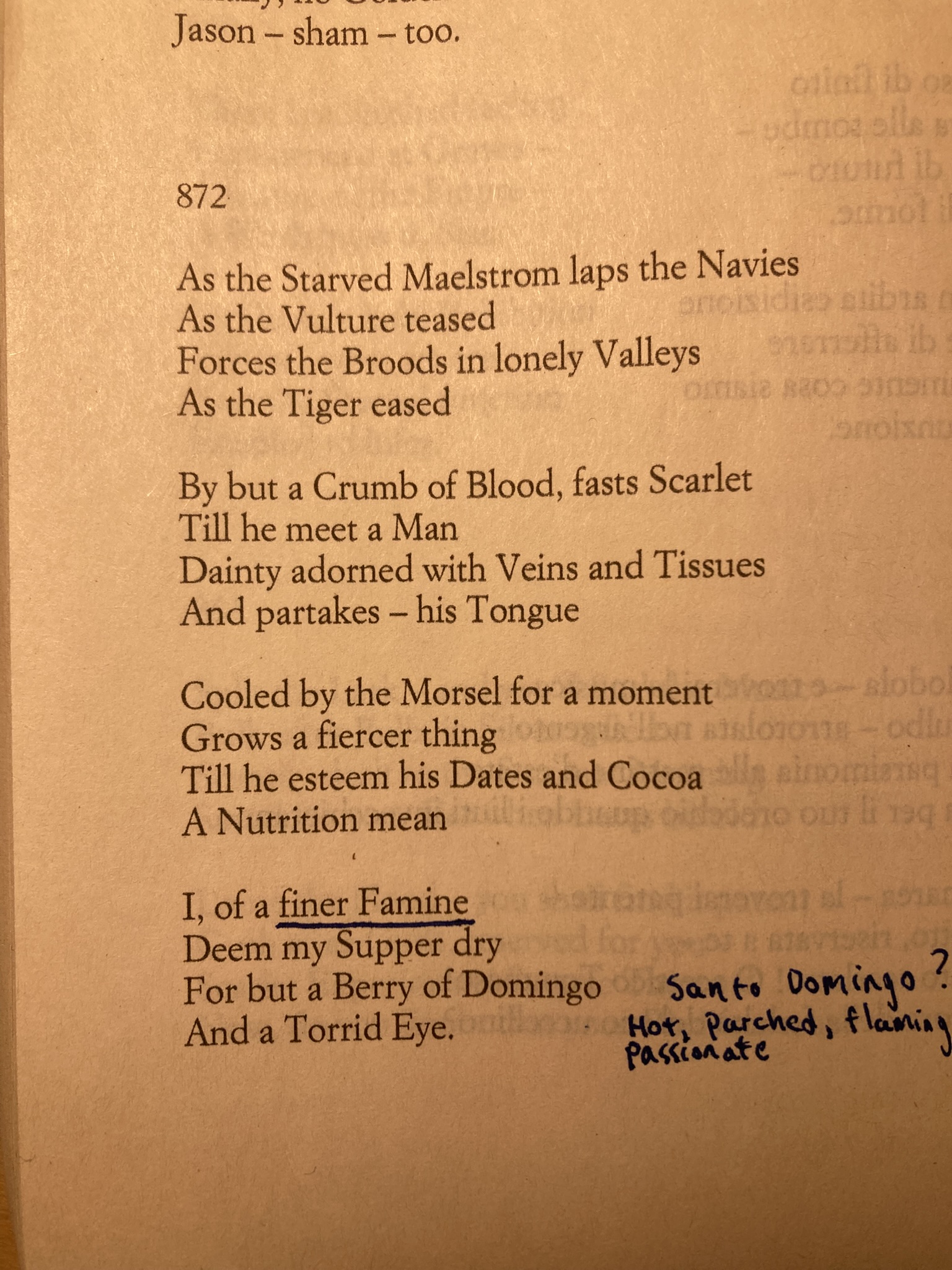
The maelstrom is circling (lapping) the navies, sharklike and hungry. So too is the vulture, forcing “broods” (sheep
or goats, prey animals) into valleys for shelter. The tiger is likewise hungry, until it meets a man “daintily
adorned” with meat. Yet, this is only a small concession, and his hunger grows fiercer, until he finds his dates and
cocoa “a nutrition mean” (a nutrition sufficient, good enough).
Now, to the Dickinson twist where the stage
has been set by the preceding stanzas. She (the human) is of a “finer famine.” She needs more than mere supper to
avoid a “dry” (unappetizing) experience. Why might this be? The answer lies in the psychological phenomenon of
hedonic adaptation/accommodation.
Animals in the wild are in a state of perpetual deprivation and hunger.
Every morsel of nutrition they find is energetically expensive, and rare. This is because they (especially
carnivores) are involved in the struggle for existence, and every bite must be killed for or competed for against
another’s will. A tiger esteems his “dates and cocoa” (something insufficient, dry, bland) as appetizing because he
is so chronically hungry.
But, humans have solved this problem of production, and have access to a food
surplus. The famine they suffer from is not a literal famine, but rather, hedonic accommodation to a relative
excess of food and drink, which reduces the pleasure felt upon consumption. If we were sufficiently
deprived of food, something we find disgusting might become palatable, and things previously only palatable would be
like a gourmet feast. This deprivation is one of two strategies to outwit hedonic adaption
(although most animals don’t do it willingly). Dickinson outlines the other strategy, novelty
seeking:
Dickinson needs a “Berry of Domingo.” I first thought she meant an actual berry from the Dominican Republic, like the
Acerola
cherry, but this clearly means something exotic or novel, something unaccustomed to. Next, she needs a
“torrid eye.” This means, a passionate, desiring, craving, hungry consciousness, and not a dispassionate,
non-craving consciousness. “Torrid” has a sexual connotation, which highlights the strength of feeling necessary to
address this new sort of famine. With these two attributes in place (novel object, eager subject) the issue is, in
theory, solved. Gustatory delight, and in fact the delight accompanied with all sensual pleasures, could be
sustained indefinitely. The finer famine need not relate to food only, it applies to the every single kind of
pleasurable experience.
Despite this theory, the world does not have that many genuine novelties, food or
otherwise, and there’s a limit. Eventually, you will exhaust the combinations of tastes, textures, and so on. One
cannot sustain a “torrid eye” for a long period, since this sensitivity is mediated by biological tissues, organs,
and organ systems that obey biological laws. The solution is either to accept a “dry meal” (suffering, boredom),
have a schedule of intentional deprivation, or have a rotation of novelties in one’s “sensual diet.”
But why
do we take such great pains to pursue, capture and cultivate various pleasures? Molecular biologist Ladislav Kovacs
makes this remark, in The biology of happiness: Chasing
pleasure and human destiny:
The emotional ‘good’, has become detached from the
Darwinian ‘good’ such that experiencing pleasure has become an end in itself. The Darwinian utility has been
displaced by the hedonic utility. Humans have become a uniquely hyperemotional animal species.
It
gives me a small satisfaction to know that in susceptibility to the hedonic treadmill, we are all truly equal. The
billionaire who receives Michelin star dishes ever night experiences no more gustatory pleasure than the starving
Raccoon who finds a half-eaten whopper in the trash. Even if the aforementioned Billionaire has the most rigorous
novelty-seeking, drug-enhanced gustation practice, he will probably not exceed the Raccoon’s pleasure.